

Digital customer service has been on an upward trajectory over the years. There are now more job vacancies for digital customer support professionals. With the current COVID-19 pandemic the demand is even higher.
When I started my career as a digital customer service representative a couple of years ago, we would handle customers directly from the native pages, that is directly from Facebook, Twitter, and Outlook, and I was being evaluated on the following areas:
Response TimeThis was readily available on the Facebook page and despite handling other platforms, only Facebook was measured.

QualityThis was more of measuring adherence to the standard responses given and how the script was followed. After some time, customers knew the responses they would get; robotic responses.
Customer Satisfaction At the end of every week, one out of hundreds of responses would be evaluated, then the client would be called to give his feedback. Whatever ratings the client gave would be my CSAT score for that particular week.
Shift AdherenceThat is punctuality to work, observing of breaks and total days worked in a particular month out of the total expected.
With more clients moving to social media, there was a need to use social media tools to handle customer inquiries. The use of tools also brought about the emergence of better key metrics. This meant that brands can respond to all clients, monitor comments and hashtags anywhere the brand is mentioned, pull better reports, and have SMART performance indicators.
The new metrics adopted were:
Productivity
It is a measure of messages published by a representative over the total number of inbound messages. We came up with this mostly to reduce the likelihood of some agents joyriding or not being as productive as their colleagues. With the introduction of this KPI, team members became more productive hence improved response time and eventually better satisfaction scores.
It is a measure of messages published by a representative over the total number of inbound messages. We came up with this mostly to reduce the likelihood of some agents joyriding or not being as productive as their colleagues. With the introduction of this KPI, team members became more productive hence improved response time and eventually better satisfaction scores.
Quality
This is still sticking to the standard responses.
This is still sticking to the standard responses.
Ticketing
For online customer service, only escalations are ticketed.
For online customer service, only escalations are ticketed.
Average Handle Time
This measures the time a representative assigns himself/herself a comment to when they click send/resolve.
This measures the time a representative assigns himself/herself a comment to when they click send/resolve.
With time, there was a need to work on the KPIs yet again..change is the only constant of life.
Below is a list of key performance indicators that we adapted for the digital customer service team:
Customer Delight
This is a mix of the quality of responses in terms of accuracy, relevance, and adaptation to the language used by a client. The goal is to wow the client through delightful responses.
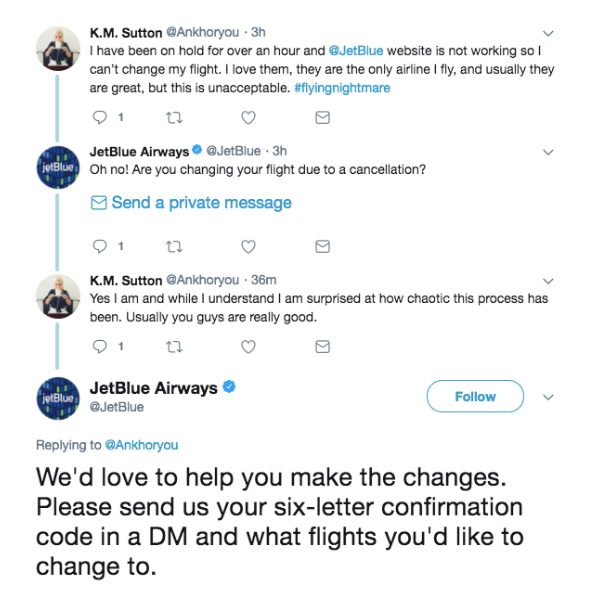 |
| A response from JetBlue Airways |
 |
| Don’t you love the hilarious responses from Safaricom? |
 |
| An example of a delightful response from SportPesa Kenya |
Tagging
This helps to keep track of the frequently asked questions. Tags can also point to areas of improvement after careful analysis of responses tagged under each category.
Response Time
This is a measure of time from when a client posted a comment to when a customer representative posts a response to the comment.
Shorter response time means that clients do not wait in queue for long.
Customer Satisfaction Score
The beauty of the metric is that questions can be customized to suit what you want to achieve.
You can ask questions like:
- On a scale of 1-10, how satisfied are you with the service you received? Satisfaction can also be measured using emojis.
- How would you rate the overall quality of your interaction with our representative (or chat-bot)?
- How can our representatives serve you better? (Give room for clients to write)
- How do you feel about our products or services?
- Describe a previous experience you have had with our product/service
- Would you recommend our services/products to your friend?
Employee Satisfaction and Engagement
This includes but not limited to:
This includes but not limited to:
- Personal development or training
- Employee engagement surveys
- Employee turnover and absenteeism rate
- Social productivity
Service Level
The following can be used to measure service level for social media:
- Response time across the different social media platforms
- Response rate
- Average Handle Time for all interactions per representative over a given period of time
Over to you…
What metrics you are using at your place of work or in your business?
What are you hoping to achieve with those metrics?
Let me know in the comments section.
Sharing is caring!

3 comments
Wow! Quite insightful on the efforts being put in by organisations to improve digital interactions with their publics.
Great article 👌
I like this. COVID-19 is pushing us towards the fourth industrial revolution. Digital and online services provision.
It's teaching us that we don't have to physically go to work to offer services, especially for the non-essential professions.
I like this. Thank you for sharing
Am sure when things get back to normal, it won't be business as usual, this, I want to believe is an eye opener to decision makers in our organizations. Some cost has to be slashed ( office space) 🤔